I just wanted to post a quick entry to let everyone know that I've recently updated the survey for the online version of the Seeking Liberty exhibit. The survey is available online and can be reached from the Seeking Liberty homepage. Or just paste this link in your address bar to fill-out the survey: http://www.surveymonkey.com/s.aspx?sm=U8gk65cK16jATnVL176_2bOQ_3d_3d%22%3EClick%20Here%20to%20take%20survey
The survey includes 10 questions and should only take about 10 minutes of your time. We love to hear your comments so please fill-out the survey when you get a chance. Also, feel free to email any comments, questions or suggestions to seekingliberty@gmail.com.
I'm continuously updating the website with new images and information so check back frequently to view the new additions.
28 October 2008


22 October 2008
More news coverage of the African bundle
Here is the video from WUSA Channel 9 news coverage of the bundle. Stay tuned as we post more media hits throughout the week.
African Cache found on Fleet Street!
Featured in yesterday's New York Times' science news and the Capital newspaper were articles on a bundle of artifacts related to African Spiritual Practices found here in the historic district of Annapolis.
Last spring while Archaeology in Annapolis was performing excavations on Fleet and Cornhill Streets we came across a particularly interesting find. Archaeologists Alethea Williams and Matt Cochran initially uncovered the tip of a stone axe blade resting vertically, approximately 4 feet below ground along the side of Fleet Street. As they excavated around the axe head they found that it was encased within a solid clay mass. They carefully removed the mass from the ground and discovered that the clay was full of pieces of lead shot along with numerous nails. The clay mass dates to the early 18th century and was of a distincly different material from the surrounding soil. The bundle was in an ovular shape and was most likely enclosed in a cloth bag which would have deteriorated over time. The Maryland Archaeological Conservation lab x-rayed the bundle and produced the following image:
 The white circles are pieces of shot, while the outline of nails and pins are also apparent. Archaeology in Annapolis has found evidence of West African Spiritual practices during other excavations inside of the Carroll House, the Brice House and Reynolds' Tavern. The cache found on Fleet Street is different though, in that it was discovered within a public context. This find was a major breakthrough because it suggests that different spiritual rituals were practiced in public and possibly were more generally accepted than we had previously thought. Archaeology in Annapolis is still working with specialists in West African Spiritual traditions to uncover the origin of this discovery. We'll keep you updated on future finds!
To view the articles visit the following links:
http://www.nytimes.com/2008/10/21/science/21arch.html?_r=2&pagewanted=1&th&emc=th&oref=slogin
http://www.hometownannapolis.com/cgi-bin/read/2008/10_21-10/CAN
Last spring while Archaeology in Annapolis was performing excavations on Fleet and Cornhill Streets we came across a particularly interesting find. Archaeologists Alethea Williams and Matt Cochran initially uncovered the tip of a stone axe blade resting vertically, approximately 4 feet below ground along the side of Fleet Street. As they excavated around the axe head they found that it was encased within a solid clay mass. They carefully removed the mass from the ground and discovered that the clay was full of pieces of lead shot along with numerous nails. The clay mass dates to the early 18th century and was of a distincly different material from the surrounding soil. The bundle was in an ovular shape and was most likely enclosed in a cloth bag which would have deteriorated over time. The Maryland Archaeological Conservation lab x-rayed the bundle and produced the following image:
 The white circles are pieces of shot, while the outline of nails and pins are also apparent. Archaeology in Annapolis has found evidence of West African Spiritual practices during other excavations inside of the Carroll House, the Brice House and Reynolds' Tavern. The cache found on Fleet Street is different though, in that it was discovered within a public context. This find was a major breakthrough because it suggests that different spiritual rituals were practiced in public and possibly were more generally accepted than we had previously thought. Archaeology in Annapolis is still working with specialists in West African Spiritual traditions to uncover the origin of this discovery. We'll keep you updated on future finds!
To view the articles visit the following links:
http://www.nytimes.com/2008/10/21/science/21arch.html?_r=2&pagewanted=1&th&emc=th&oref=slogin
http://www.hometownannapolis.com/cgi-bin/read/2008/10_21-10/CAN
13 October 2008
Dr. Kelso to speak at the Naval Academy
This Tuesday night at the Naval Academy in Annapolis, Dr. William Kelso will give a lecture entitled "Jamestown: The Buried Truth." In 1607, 104 English men and boys landed on the James River, built a fort and established Jamestown, what was the first permanent English settlement in the Americas. Dr. Kelso is the Director of Archaeology at Jamestown and oversaw excavations of the 1607 James Fort. This should be a really interesting talk... Hope to see you there!
The lecture is open to the public and will begin at 7:15 in Mahan Auditorium. For more information on entering the Naval Academy visit their website: www.usna.edu
View the announcement in the Capital newspaper: http://www.hometownannapolis.com/cgi-bin/read/2008/10_12-52/TOP
For more information on archaeology at Jamestown see the following sites:
http://www.apva.org/jr.html
http://historicjamestowne.org/
The lecture is open to the public and will begin at 7:15 in Mahan Auditorium. For more information on entering the Naval Academy visit their website: www.usna.edu
View the announcement in the Capital newspaper: http://www.hometownannapolis.com/cgi-bin/read/2008/10_12-52/TOP
For more information on archaeology at Jamestown see the following sites:
http://www.apva.org/jr.html
http://historicjamestowne.org/
09 October 2008
Anne Arundel County Courthouse: Part I
 While archaeologists are making exciting discoveries at the Charles County Courthouse site, I thought I would highlight some of the history of the Anne Arundel County Courthouse block right here in Annapolis, MD. The Anne Arundel County Courthouse and the Banneker-Douglass Museum are actually located on the same city block in the Historic District of Annapolis.
The map to the right dates to around 1890. You can see the original size of the courthouse and the AME Church which is now part of the Banneker-Douglass Museum. The addition to the museum, built in 2003, extends about 50 feet toward the courthouse along Doctor Street (now Franklin Street). The remaining yellow and pink blocks on the map represent houses and small businesses. As a result of development over the past century the remainder of the Courthouse Block is now occupied by additions to the courthouse.
In 2000 and 2001 Archaeology in Annapolis held summer Field Schools on the courthouse block prior to the construction of the museum addition. Students excavated privies, former backyards, cellars and house foundations. They discovered the material remains of the culturally and ethnically varied residents of the courthouse block.
In 1897 Bellis Court was built in the center of the Courthouse Block. This alley community was composed of predominantly low-income African-Americans who according to census records worked almost exclusively as laborers. By 1951 Bellis Court and all the houses along South Street had disappeared and were eventually replaced by courthouse additions. Archaeologists recovered a large amount of buttons while excavating what would have been the backyard area of the Bellis Court houses. In a time when employment was severely limited for African-Americans many female residents of the Courthouse Block worked as washerwomen.
Check back for Part II including more details about excavations at the Courthouse.
29 September 2008
Charles County Courthouse
Speaking of archaeology in the news. There was an article in The Capital recently about an important discovery in Charles County. It seems that archaeologists from St. Mary's College of Maryland have discovered the original Charles County courthouse which dates to the 1620s.
The courthouse has taken almost 75 years to locate. The group of archaeologists led by St. Mary's professor Julia King were able to identify the courthouse due to an unusually large amount of artifacts found while digging test pits. Shovel test pits commonly known as STPs are a standard in the early stages of excavation and are a common way for archaeologists to assess where cultural remains may or may not be located on a given site. STPs are usually laid out in a grid over the project area. Archaeologists then dig small test holes typically only a foot to a foot and a half in diameter in order to determine artifact densities. Based on the results from the STPS, archaeologists determine if further excavation is necessary. STPs are most commonly used for Cultural Resourse Management(CRM) work.
Among the artifacts found at the courthouse were a large number of glass and ceramic shards from wine bottles, beer tankards and drinking vessels. Professor King explained that it was common practice for judges and councilmen to drink while at the courthouse. According to King there are no 17th century buildings which still exist in Maryland or Virginia so to find the foundation of an early government building like this is very significant.
For more information on the Courthouse find see the following Capital and Washington Post articles:
http://www.hometownannapolis.com/cgi-bin/read/2008/09_16-11/REG
http://www.washingtonpost.com/wp-dyn/content/article/2008/06/08/AR2008060802057.html
The courthouse has taken almost 75 years to locate. The group of archaeologists led by St. Mary's professor Julia King were able to identify the courthouse due to an unusually large amount of artifacts found while digging test pits. Shovel test pits commonly known as STPs are a standard in the early stages of excavation and are a common way for archaeologists to assess where cultural remains may or may not be located on a given site. STPs are usually laid out in a grid over the project area. Archaeologists then dig small test holes typically only a foot to a foot and a half in diameter in order to determine artifact densities. Based on the results from the STPS, archaeologists determine if further excavation is necessary. STPs are most commonly used for Cultural Resourse Management(CRM) work.
Among the artifacts found at the courthouse were a large number of glass and ceramic shards from wine bottles, beer tankards and drinking vessels. Professor King explained that it was common practice for judges and councilmen to drink while at the courthouse. According to King there are no 17th century buildings which still exist in Maryland or Virginia so to find the foundation of an early government building like this is very significant.
For more information on the Courthouse find see the following Capital and Washington Post articles:
http://www.hometownannapolis.com/cgi-bin/read/2008/09_16-11/REG
http://www.washingtonpost.com/wp-dyn/content/article/2008/06/08/AR2008060802057.html
26 September 2008
London Uncovered
Archaeology has been in the news quite a bit lately with many digs and their findings being presented to the public. The finds have been all over the map both literally and figuratively.  From the discovery of a 1,900 year old Thracian chariot in Bulgaria to the uncovering of a 3,000 year old head of Ramses II from a large statue in Egypt to the uncovering of Shakespeare's first theater in London. The stories have been really interesting to watch. I never realized how frequently archaeology came up in the media until this exhibit opened and now I can't stop seeing archaeology articles. I suppose it goes to show how aware I have been.
The article on the London findings particularly caught my eye as the images from the digs on the Museum of London Archaeology Service website somewhat resemble the digs that took place this summer in downtown Annapolis. The picture on the left really reminded me of some of the backyards along Fleet and Cornhill Streets. The two digs also have similarities in that they were conducted metropolitain areas in preparation of construction projects. Annapolis was preparing for utility undergrounding while London was studying the site as the home of a new theater.


Annapolis
 From the discovery of a 1,900 year old Thracian chariot in Bulgaria to the uncovering of a 3,000 year old head of Ramses II from a large statue in Egypt to the uncovering of Shakespeare's first theater in London. The stories have been really interesting to watch. I never realized how frequently archaeology came up in the media until this exhibit opened and now I can't stop seeing archaeology articles. I suppose it goes to show how aware I have been.
The article on the London findings particularly caught my eye as the images from the digs on the Museum of London Archaeology Service website somewhat resemble the digs that took place this summer in downtown Annapolis. The picture on the left really reminded me of some of the backyards along Fleet and Cornhill Streets. The two digs also have similarities in that they were conducted metropolitain areas in preparation of construction projects. Annapolis was preparing for utility undergrounding while London was studying the site as the home of a new theater.


Annapolis
18 September 2008
Tree dedication
Yesterday was the dedication ceremony of the Honey Locust Memorial tree in the backyard of the Maynard-Burgess House. Everyone gathered around 2pm to hear opening remarks by the Mayor of Annapolis, Ellen Moyer. Janice Hayes Williams, a prominent African American Historian for the City of Annapolis also talked to the audience about the Maynard and Burgess families and generally what life was like for free African Americans in Annapolis. Dr. Mark Leone spoke on the archaeological finds that were recovered at the site during excavations in the 1990s. Lastly, Mamie Williams of Fowler's Methodist Church gave a blessing of the tree which included a prayer and song. Two decedents of Willis Burgess attended and officially uncovered the dedication plaque for all to see. Archaeology in Annapolis displayed artifacts from the excavations and the Mayor's Office produced signs interpreting the archaeology from the site.
As Mayor Moyer explained this dedication was the first step in transforming the backyard of the Maynard-Burgess House into a representation of a 19th century working yard. While performing archaeology at the house in the early 1990s archaeologists found the remains of a privy which was full of household refuse including bottles and ceramics. From census records we know that members of the Maynard and Burgess families worked as laundresses. Archaeologists found an unusually large amount of buttons in the yard to support this information. A privy and a clothes line will be included in the representation of the 19th century yard as well as a small garden. It was typical for middle class families in the 19th century to maintain small gardens as a means of supplementing their groceries. While Annapolis has many house museums this will be an especially important site because it will be the only representation of a free African-American household.
Work on the backyard will take place over the coming year with the site opening to the public sometime in 2009.
As Mayor Moyer explained this dedication was the first step in transforming the backyard of the Maynard-Burgess House into a representation of a 19th century working yard. While performing archaeology at the house in the early 1990s archaeologists found the remains of a privy which was full of household refuse including bottles and ceramics. From census records we know that members of the Maynard and Burgess families worked as laundresses. Archaeologists found an unusually large amount of buttons in the yard to support this information. A privy and a clothes line will be included in the representation of the 19th century yard as well as a small garden. It was typical for middle class families in the 19th century to maintain small gardens as a means of supplementing their groceries. While Annapolis has many house museums this will be an especially important site because it will be the only representation of a free African-American household.
Work on the backyard will take place over the coming year with the site opening to the public sometime in 2009.
12 September 2008
Charles Carroll House Cache
One of the most popular and intriguing portions of the Seeking Liberty exhibit is the Brice House material which includes a model of the East wing of the house that was excavated by Archaeology in Annapolis in 1998. In the basement of the east wing archaeologists discovered a series of caches or distinct, intentional deposits of material placed there by African Americans in order to control spirits which is a common practice in West African cultures. What many may not know is that Archaeology in Annapolis discovered a similar cache at the Charles Carroll House in 1991.

Dr. Robert Worden was a volunteer excavator at the site when he discovered a white ceramic bowl with a blue asterisk placed upside down approximately 18 inches beneath the modern dirt floor of the East wing of the Carroll House. When he removed the broken ceramic bowl he found that it had been placed over a whole array of other artifacts including 14 rock crystals, a half-dozen white bone discs, a smooth black pebble, two coins (one dated 1790 and the other 1810) and a number of straight pins.
The finds were published in an article in the Sunday Times on September 15, 1991. That Monday Dr. Frederick Lamp, Curator of African Art at the Baltimore Museum of Art telephoned to suggest that the materials were a spirit bundle associated with West African culture. Lamp further explained that within this tradition crystals were used to contain spirits and that the four holes on the buttons most likely represented a cosmogram. A cosmogram is a symbol of the vertical world axis and the horizon showing a divide between the worlds of the living and the dead. These items were most likely placed in the ground by spiritual practitioners to control spirits for various purposes, especially to protect inhabitants. No one in Annapolis had ever found anything tied so clearly to African culture.
Before these discoveries many thought that African cultural traditions did not survive the Middle Passage. The cache at the Carroll House provided compelling evidence that Africans did retain religious practices in the New World well into the 19th century. Thus, the history of Annapolis was no longer strictly European it also contains clear African influence as well.
The cache of materials from the Carroll House are currently on display at the History Quest Welcome Center in Annapolis located at 99 Main Street right near the city dock. For details see their website: http://www.annapolis.org/index.asp?pageid=44
For more on the Carroll House finds see Dr. Mark Leone's book "The Archaeology of Liberty in An American Capital: Excavations in Annapolis" (2005).

The finds were published in an article in the Sunday Times on September 15, 1991. That Monday Dr. Frederick Lamp, Curator of African Art at the Baltimore Museum of Art telephoned to suggest that the materials were a spirit bundle associated with West African culture. Lamp further explained that within this tradition crystals were used to contain spirits and that the four holes on the buttons most likely represented a cosmogram. A cosmogram is a symbol of the vertical world axis and the horizon showing a divide between the worlds of the living and the dead. These items were most likely placed in the ground by spiritual practitioners to control spirits for various purposes, especially to protect inhabitants. No one in Annapolis had ever found anything tied so clearly to African culture.
Before these discoveries many thought that African cultural traditions did not survive the Middle Passage. The cache at the Carroll House provided compelling evidence that Africans did retain religious practices in the New World well into the 19th century. Thus, the history of Annapolis was no longer strictly European it also contains clear African influence as well.
The cache of materials from the Carroll House are currently on display at the History Quest Welcome Center in Annapolis located at 99 Main Street right near the city dock. For details see their website: http://www.annapolis.org/index.asp?pageid=44
For more on the Carroll House finds see Dr. Mark Leone's book "The Archaeology of Liberty in An American Capital: Excavations in Annapolis" (2005).
09 September 2008
If a tree falls in the forest...
I was recently in a meeting discussing the use of technology by historic sites in Anne Arundel County when we began talking about the use of blogs as a very user-friendly means of talking about what historic sites are up to. One of the meeting attendees commented on the blog at Port Tobacco here in Maryland as one of the better examples. This blog provides information as to the status or projects, new ideas, and what staff members are up to in bite-sized amounts which gave you quite a bit of detail without being overwhelming and conveying the excitement and energy the writer is feeling towards a particular project. As I was reading the blog, I found myself thinking about how information is provided to visitors by museums and vice versa and how it it changing.
Using Seeking Liberty as an example, we have tried to provide information in four different ways, each one with differing approaches and results. The first method is through the exhibition itself. The exhibit has physical objects, labels, and text panels - all things expected in a museum exhibition. The exhibition has been extremely popular with visitors near and far, with many people coming specifically to see this exhibit. Within the exhibition is a survey asking visitors to take a few minutes to provide us their feedback. I am very interested in the fact that few visitors fill out the forms and when they do, they do not leave us much feedback. However, in our permanent exhibition on the second floor, we have a nearly identical survey which is filled out quite frequently. On this form we ask visitors to rate different experiences they had in the exhibit as well as tell us how they connected with the exhibition. On the permanent gallery forms, we receive quite a bit of feedback - sometimes quite extensive feedback. In Seeking Liberty, that is not the case. The forms, when they are filled out, generally only have numeric answers without any comments.
At first I found this to be rather disheartening. I found myself asking whether or not the visitors were truly engaging in the exhibit or were they simply walking into the exhibit and walking out, following the directions of the security guard to go into the first room they saw. I saw some truth to that when I worked the front desk and would provide a different overview of the museum and would not direct the visitors to immediately enter the exhibit they were standing next to. After doing so, I found that visitors would often actually choose to go to the permanent exhibition first. What did that mean for the attracting power of Seeking Liberty? Is this exhibit not as engaging as we once thought? Are people simply not engaging with the subject matter beyond what they read within the exhibit? Do they not take anything out of the museum from the exhibit?
I ended up getting my answer in a very unexpected place - this blog. One of the major concerns many museum folks have it that if you put exhibitions and exhibition content online, people will not want to actually come and see the physical exhibit. My argument has always been that putting information online is a way of attracting visitors to the exhibition and to allow people who will never be able to see the physical exhibit a means of accessing it. To put in another way, if someone does not have the means to go to Paris themselves, does that mean that looking at images, reading about the city, and owning Paris-themed objects will deter them from ever wanting to actually go?
When reviewing the statistics for this blog and the exhibition website I was very surprised to learn that while people are not necessarily filling out the evaluation forms, they are giving us feedback through their visitation to the blog. We are seeing that many visitors have come to the museum and then gone home to view the website and blog. This showed me that perhaps I was a bit hasty in my thinking that people are not getting anything out of the exhibit because they were not filling out paper forms. The return visits, to me, are far more gratfying because they show me that people are enjoying the exhibition so much that they are willing to give the museum a second visit - this time virtually.
If you visited the exhibit at the museum and this blog, which did you visit first? What made you come back for a second look at Seeking Liberty? If you have only seen this blog, or the exhibit's website for that matter, has it stopped you from wanting to come to the museum to see the physical exhibit?
Using Seeking Liberty as an example, we have tried to provide information in four different ways, each one with differing approaches and results. The first method is through the exhibition itself. The exhibit has physical objects, labels, and text panels - all things expected in a museum exhibition. The exhibition has been extremely popular with visitors near and far, with many people coming specifically to see this exhibit. Within the exhibition is a survey asking visitors to take a few minutes to provide us their feedback. I am very interested in the fact that few visitors fill out the forms and when they do, they do not leave us much feedback. However, in our permanent exhibition on the second floor, we have a nearly identical survey which is filled out quite frequently. On this form we ask visitors to rate different experiences they had in the exhibit as well as tell us how they connected with the exhibition. On the permanent gallery forms, we receive quite a bit of feedback - sometimes quite extensive feedback. In Seeking Liberty, that is not the case. The forms, when they are filled out, generally only have numeric answers without any comments.
At first I found this to be rather disheartening. I found myself asking whether or not the visitors were truly engaging in the exhibit or were they simply walking into the exhibit and walking out, following the directions of the security guard to go into the first room they saw. I saw some truth to that when I worked the front desk and would provide a different overview of the museum and would not direct the visitors to immediately enter the exhibit they were standing next to. After doing so, I found that visitors would often actually choose to go to the permanent exhibition first. What did that mean for the attracting power of Seeking Liberty? Is this exhibit not as engaging as we once thought? Are people simply not engaging with the subject matter beyond what they read within the exhibit? Do they not take anything out of the museum from the exhibit?
I ended up getting my answer in a very unexpected place - this blog. One of the major concerns many museum folks have it that if you put exhibitions and exhibition content online, people will not want to actually come and see the physical exhibit. My argument has always been that putting information online is a way of attracting visitors to the exhibition and to allow people who will never be able to see the physical exhibit a means of accessing it. To put in another way, if someone does not have the means to go to Paris themselves, does that mean that looking at images, reading about the city, and owning Paris-themed objects will deter them from ever wanting to actually go?
When reviewing the statistics for this blog and the exhibition website I was very surprised to learn that while people are not necessarily filling out the evaluation forms, they are giving us feedback through their visitation to the blog. We are seeing that many visitors have come to the museum and then gone home to view the website and blog. This showed me that perhaps I was a bit hasty in my thinking that people are not getting anything out of the exhibit because they were not filling out paper forms. The return visits, to me, are far more gratfying because they show me that people are enjoying the exhibition so much that they are willing to give the museum a second visit - this time virtually.
If you visited the exhibit at the museum and this blog, which did you visit first? What made you come back for a second look at Seeking Liberty? If you have only seen this blog, or the exhibit's website for that matter, has it stopped you from wanting to come to the museum to see the physical exhibit?
28 August 2008
Lion of Baltimore
The Capital published an article today outlining a new project for the Maritime and Archaeological Historical Society. They are launching, with the assistance of a grant from the Maryland Historical Trust, a land and water survey of Bodkin Creek in an effort to find the remains of the Lion of Baltimore and a now-vanished lighthouse at Bodkin Point.
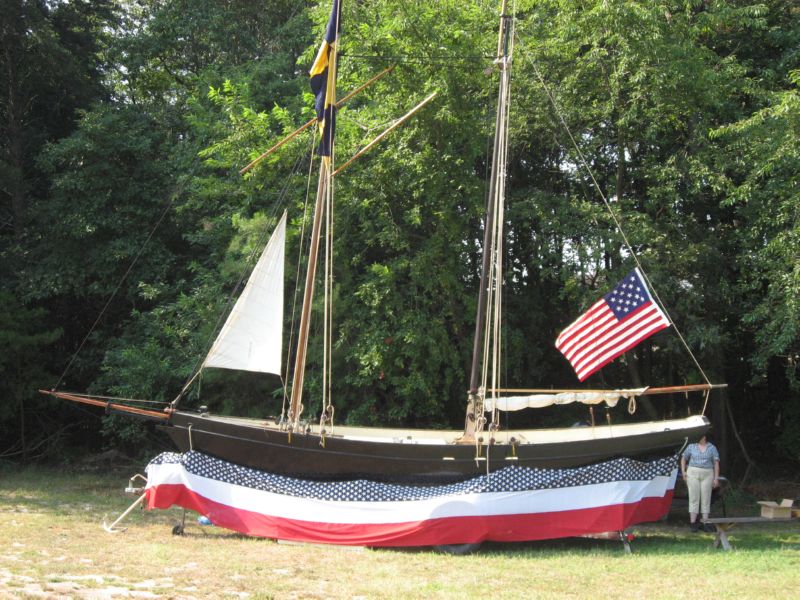
The Lion of Baltimore was one of the famous Baltimore Clipper ships known for their speed and agility, even in shallow waters. The ship was lost in 1814 at the Battle of Bodkin Creek when it was burned by the British during the War of 1812. If the search is successful, it would be one of the first times a clipper ship has been found.
Divers will be searching this location as well as the rest of Bodkin Creek and parts of the Chesapeake Bay over the next week and a half. If anyone has any suggestions for where in the Bodkin divers should look, contact Brian Jordan, assistant underwater archaeologist for the Maryland Historical Trust at 410.514.7668.
One of the intriguing parts of the article talks about a man reporting to have seen a schooner ship off his property two years ago after a storm. The comment couldn't stop my mind from wandering to the idea of a Loch Ness Monster in the area.
Click here to read today's article.
Click here for 2003 article published in the LA Times on the search for the Lion of Baltimore.
Click here for a 2007 article published in the Maryland Gazette on the history of the Lion of Baltimore.
The Lion of Baltimore was one of the famous Baltimore Clipper ships known for their speed and agility, even in shallow waters. The ship was lost in 1814 at the Battle of Bodkin Creek when it was burned by the British during the War of 1812. If the search is successful, it would be one of the first times a clipper ship has been found.
Divers will be searching this location as well as the rest of Bodkin Creek and parts of the Chesapeake Bay over the next week and a half. If anyone has any suggestions for where in the Bodkin divers should look, contact Brian Jordan, assistant underwater archaeologist for the Maryland Historical Trust at 410.514.7668.
One of the intriguing parts of the article talks about a man reporting to have seen a schooner ship off his property two years ago after a storm. The comment couldn't stop my mind from wandering to the idea of a Loch Ness Monster in the area.
Click here to read today's article.
Click here for 2003 article published in the LA Times on the search for the Lion of Baltimore.
Click here for a 2007 article published in the Maryland Gazette on the history of the Lion of Baltimore.
18 August 2008
Thomas Jefferson's Toothbrush!
While doing some reading for this week's Featured Artifact I came across another really interesting artifact:
 This bone toothbrush handle was found in 1988 during excavations at Colonial Williamsburg. The handle is engraved with the name “Thos. Jefferson.” Thomas Jefferson did live at Williamsburg when he served as the second Governor of the Commonwealth of Virginia beginning in 1779. Jefferson left Williamsburg in 1780 when the capitol was moved from Williamsburg to Richmond. The toothbrush handle was found in a trash deposit near the Governor's Palace. According to the context of the find, archaeologists know that the toothbrush handle was discarded in the late 18th century and therefore almost certainly belonged to Thomas Jefferson, third president of the United States.
It is extremely rare to recover an artifact that can be connected to a specific person. While this is an exciting find it doesn't really tell archaeologists anything they didn't already know. Historical Archaeoloy is actually more useful for accessing the cultural remains of those who we don't already know much about because they were left out of written history, typically the lower class, women and minorities.
For more information on Thomas Jefferson's toothbrush and other archaeological finds at Williamsburg visit their website:
http://www.history.org/history/teaching/enewsletter/may03/iotm.cfm
 This bone toothbrush handle was found in 1988 during excavations at Colonial Williamsburg. The handle is engraved with the name “Thos. Jefferson.” Thomas Jefferson did live at Williamsburg when he served as the second Governor of the Commonwealth of Virginia beginning in 1779. Jefferson left Williamsburg in 1780 when the capitol was moved from Williamsburg to Richmond. The toothbrush handle was found in a trash deposit near the Governor's Palace. According to the context of the find, archaeologists know that the toothbrush handle was discarded in the late 18th century and therefore almost certainly belonged to Thomas Jefferson, third president of the United States.
It is extremely rare to recover an artifact that can be connected to a specific person. While this is an exciting find it doesn't really tell archaeologists anything they didn't already know. Historical Archaeoloy is actually more useful for accessing the cultural remains of those who we don't already know much about because they were left out of written history, typically the lower class, women and minorities.
For more information on Thomas Jefferson's toothbrush and other archaeological finds at Williamsburg visit their website:
http://www.history.org/history/teaching/enewsletter/may03/iotm.cfm
15 August 2008
You never know what you are going to get...
The Washington Post published a fascinating article today on an archaeological dig in the Sahara Desert which has the remains of two different groups of people over a 5,000 year period. The article details how the site was found in 2000 when University of Chicago paleontologist Paul Sereno was searching for dinosaur bones in Niger and came across this site. He returned three years later with researchers from several different countries to dig at the site.
The article is fascinating in that it is proof that you never know that you will find when you are digging.

Archaeologist Elena Garcea of the University of Cassino in Italy brushes sand from a skeleton at Gobero. Garcea, who has spent nearly three decades excavating Stone Ages sites in northern Africa, used pot sherds and other artifacts to help identify Kiffian and Tenerian cultures at Gobero. Photo © Mike Hettwer, courtesy Project Exploration.
http://www.projectexploration.org
Click here to see the article from the Washington Post.
Click here to link to Project Exploration's website for more information, videos, and images.
The article is fascinating in that it is proof that you never know that you will find when you are digging.
Archaeologist Elena Garcea of the University of Cassino in Italy brushes sand from a skeleton at Gobero. Garcea, who has spent nearly three decades excavating Stone Ages sites in northern Africa, used pot sherds and other artifacts to help identify Kiffian and Tenerian cultures at Gobero. Photo © Mike Hettwer, courtesy Project Exploration.
http://www.projectexploration.org
Click here to see the article from the Washington Post.
Click here to link to Project Exploration's website for more information, videos, and images.
11 August 2008
More than just digging...
Today I thought I would address a frequently asked question. What happens to the artifacts archaeologists find once the excavations have ended?
Archaeologists actually spend a majority of their time in the Laboratory processing and analyzing artifacts. Archaeology in Annapolis has completed the Fleet-Cornhill Mitigation project and the summer Field School and now we have artifacts recovered from almost 14 weeks of excavation to process. The estimation is that for every week spent in the field excavating archaeologists
spend a month in the lab processing the artifacts.
The first step in processing collections involves washing all the artifacts. There are specific standards for washing artifacts which vary according to the material and the condition of the artifact. This is also the point where archaeologists identify artifacts that require special conservation attention and then create a plan of action to address these needs.
Next we must catalog the collection which is a way of recording a description of each artifact along with all other artifacts found within the same provenience. Provenience is the single most important word within the discipline of archaeology. Provenience refers to the three-dimensional context or location of an archaeological find which allows us to date our discoveries and is essential to the interpretation of a site. Next we carefully label each artifact with provenience information. Ideally we try to label the object itself so that the information cannot be separated from the object. Artifacts are stored permanently in temperature and humidity controlled facilities to reduce the rate of deterioration. The idea is to preserve and store these artifacts indefinitely for future research.
The next stage is the interpretation. For each site excavated, archaeologists must produce a site report which interprets and explains the archaeological finds. Site reports vary according to location and time period of the site but most historical archaeology site reports contain similar elements. Before excavation begins archaeologists perform documentary research in order to understand the site they are digging. This background information is included in the report. Each unit, which refers to the individual holes dug on the site, has a section in the site report. Each of these sections generally includes a brief level-by-level description of how the unit was excavated and then gives greater detail on significant finds including drawings and/or photographs. Cultural Resource Management site reports also include a section for "recommendations" where the the archaeologists make suggestions as to the future care and preservation of the historical site.
Many archaeologists try to publish their findings in a professional journal or if possible a more main-stream publication in order to reach a larger audience. Archaeology in Annapolis certainly has plenty of work to do in the next few months- we'll keep you posted!
The Society for Historical Archaeology provides a great outline for how to properly process an archaeology collection. Here's the link: http://www.sha.org/research_resources/curation_standards.htm
Archaeologists actually spend a majority of their time in the Laboratory processing and analyzing artifacts. Archaeology in Annapolis has completed the Fleet-Cornhill Mitigation project and the summer Field School and now we have artifacts recovered from almost 14 weeks of excavation to process. The estimation is that for every week spent in the field excavating archaeologists
spend a month in the lab processing the artifacts.
The first step in processing collections involves washing all the artifacts. There are specific standards for washing artifacts which vary according to the material and the condition of the artifact. This is also the point where archaeologists identify artifacts that require special conservation attention and then create a plan of action to address these needs.
Next we must catalog the collection which is a way of recording a description of each artifact along with all other artifacts found within the same provenience. Provenience is the single most important word within the discipline of archaeology. Provenience refers to the three-dimensional context or location of an archaeological find which allows us to date our discoveries and is essential to the interpretation of a site. Next we carefully label each artifact with provenience information. Ideally we try to label the object itself so that the information cannot be separated from the object. Artifacts are stored permanently in temperature and humidity controlled facilities to reduce the rate of deterioration. The idea is to preserve and store these artifacts indefinitely for future research.
The next stage is the interpretation. For each site excavated, archaeologists must produce a site report which interprets and explains the archaeological finds. Site reports vary according to location and time period of the site but most historical archaeology site reports contain similar elements. Before excavation begins archaeologists perform documentary research in order to understand the site they are digging. This background information is included in the report. Each unit, which refers to the individual holes dug on the site, has a section in the site report. Each of these sections generally includes a brief level-by-level description of how the unit was excavated and then gives greater detail on significant finds including drawings and/or photographs. Cultural Resource Management site reports also include a section for "recommendations" where the the archaeologists make suggestions as to the future care and preservation of the historical site.
Many archaeologists try to publish their findings in a professional journal or if possible a more main-stream publication in order to reach a larger audience. Archaeology in Annapolis certainly has plenty of work to do in the next few months- we'll keep you posted!
The Society for Historical Archaeology provides a great outline for how to properly process an archaeology collection. Here's the link: http://www.sha.org/research_resources/curation_standards.htm
02 August 2008
Tenement Museum
I just got back from a trip to New York City and while we were there I visited a really great house museum called the Lower East Side Tenement Museum. The building was erected in the 1860s and was home to an estimated 7,000 people between then and the 1930s. At any one time this single address housed around 20 families.
I went on the "Getting by Tour" which took us to the apartments of the German-Jewish Gumpertz family who lived at the address in the 1870s and the Sicilian-Catholic Baldizzi family who were there in the 1930s. Each of the apartments were around 300 square feet and had a small bedroom, a kitchen area and a small living room. Of course due to the size of the apartments all of the these rooms doubled as living, dining and work spaces. There were outhouses in the back yard for the 20 families until the early 1900s when they received indoor pluming. After that each floor had two bathrooms to share between the 4 apartments on each floor. In the early 20th century they ran electricity to the tenement building.
Much of the information known about the Gumpertz family was taken from historical documentation. They showed us pictures of the family members as well as census records and citizenship papers and used these documents to tell the story. As for the second apartment (pictured here), the museum was able to contact a member of the Baldizzi family that lived in the tenement as a young girl. They have around 15 hours of oral history interviews with her and she played a major part in helping reconstruct the apartment as she remembered it for the museum. They played a few minutes of the oral history recording for us where she describes her mother and some of her daily activities.
At the end of the tour they took us into what they call the "Ruin Room" which is an apartment left exactly as the museum found it in 1988. The guide wrapped up the tour by talking about current immigration in the city. I asked if there had been any archaeology done at the museum. The guide said that archaeologists had excavated the backyard and had found the privy and they are currently excavating the cellar area. As you can imagine they found a tremendous amount of domestic material but beyond that the guide couldn't give me too many details.
For me this museum was so interesting because it wasn't about one time period or one group of people. It was about the urban immigration experience as a whole. It managed to tie so many different types of people together but also kept it personal and relevant to the present. If you're in NYC I recommend a visit. Don't forget to ask about the archaeology!
For more information on the museum check out their website: http://www.tenement.org/index.htm
I went on the "Getting by Tour" which took us to the apartments of the German-Jewish Gumpertz family who lived at the address in the 1870s and the Sicilian-Catholic Baldizzi family who were there in the 1930s. Each of the apartments were around 300 square feet and had a small bedroom, a kitchen area and a small living room. Of course due to the size of the apartments all of the these rooms doubled as living, dining and work spaces. There were outhouses in the back yard for the 20 families until the early 1900s when they received indoor pluming. After that each floor had two bathrooms to share between the 4 apartments on each floor. In the early 20th century they ran electricity to the tenement building.
Much of the information known about the Gumpertz family was taken from historical
 documentation. They showed us pictures of the family members as well as census records and citizenship papers and used these documents to tell the story. As for the second apartment (pictured here), the museum was able to contact a member of the Baldizzi family that lived in the tenement as a young girl. They have around 15 hours of oral history interviews with her and she played a major part in helping reconstruct the apartment as she remembered it for the museum. They played a few minutes of the oral history recording for us where she describes her mother and some of her daily activities.
At the end of the tour they took us into what they call the "Ruin Room" which is an apartment left exactly as the museum found it in 1988. The guide wrapped up the tour by talking about current immigration in the city. I asked if there had been any archaeology done at the museum. The guide said that archaeologists had excavated the backyard and had found the privy and they are currently excavating the cellar area. As you can imagine they found a tremendous amount of domestic material but beyond that the guide couldn't give me too many details.
For me this museum was so interesting because it wasn't about one time period or one group of people. It was about the urban immigration experience as a whole. It managed to tie so many different types of people together but also kept it personal and relevant to the present. If you're in NYC I recommend a visit. Don't forget to ask about the archaeology!
For more information on the museum check out their website: http://www.tenement.org/index.htm
Subscribe to:
Posts (Atom)